
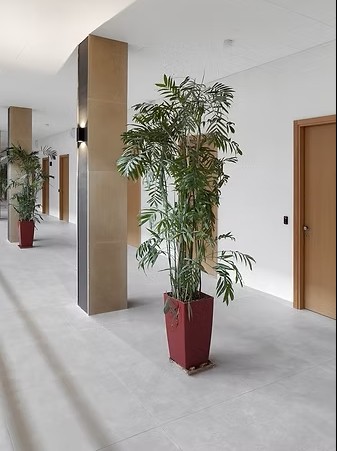
The lobby creates the first impression that we and our guests receive when entering a building or office. Beyond the impression you want to leave on visitors, the residents are the ones who encounter the lobby every day as they enter and exit the building. Creating an inviting space will enhance residents’ comfort and increase the value of the apartments. In an office building lobby renovation, a well-designed and welcoming space will upgrade the business and brand it as a serious and successful enterprise. Lobby renovation can be carried out as a standalone project or as part of a broader building renovation and reinforcement.
A company of professional and experienced contractors, engineers, architects, and structural engineers whose role is to assess feasibility and present alternatives according to the on-site conditions and the residents’ unique needs.
We will help you choose the balcony type that suits you best.
The first step in adding a safe room (Mamad) in a residential building is obtaining the residents’ approval (in a detached private home, you must get confirmation from the neighbors that they do not object to the addition).
According to Section 71 of the Real Estate Law, building a safe room (Mamad) requires the approval of 60% of the building’s residents.
If you have obtained the approval of the majority of the residents, you can proceed to the planning stage and the issuance of building permits, which will be submitted by an engineer or architect in accordance with the Home Front Command guidelines and civil defense regulations.
Note: An objecting resident cannot be forced to add a safe room (Mamad) or contribute to the construction costs, but it is possible to bypass and "skip" the objecting apartment by building a mock Mamad in accordance with the local committee’s building regulations.
After obtaining the building permit, construction work can begin on-site, with the contractor ensuring compliance with the Home Front Command’s approved standard for building a residential safe room (Mamad) and under the joint supervision of a construction inspector.
Building a safe room (Mamad) in an existing building presents unique engineering challenges. The structural engineer must carefully plan the method of connecting the new safe room to the existing structure in order to ensure the stability of both.
The choice of construction method and the location of the protected room mainly depend on engineering and structural considerations.
Ramon Engineering and Construction Group includes certified engineers, architects, and structural engineers with extensive experience in planning safe rooms (Mamads). Our team of experts presents residents with the available alternatives and assists them in choosing the most suitable construction method and the optimal location for the safe room, while taking into account residents’ needs and complying with Home Front Command regulations.
A safe room (Mamad) is built as a cube with reinforced concrete walls that extend down to the building’s foundations, giving it greater strength and durability compared to the rest of the structure.
According to the regulations, the internal area of the safe room (net—excluding walls) must be at least 9 square meters, unless approval is granted by the Home Front Command for a smaller area, but in any case not less than 5 square meters net. The height of the safe room must be no less than 2.5 meters and no more than 2.8 meters (unless special approval is given by the planning committee), and its width must be no less than 1.60 meters.
• Blast- and fragment-resistant door – opens outward and is designed to prevent the penetration of blast waves and shrapnel, as well as to provide sealing.
• Blast- and fragment-resistant window – includes an external steel protective window that opens outward (or slides) and is designed to prevent the penetration of blast waves and shrapnel, as well as a glass window that does not need to be removed in an emergency (i.e., single-sash), primarily used for sealing and helping to reduce the force of the blast. In safe rooms with a double-sash glass window (which must be removed in an emergency), the external steel window also serves as the sealing component.
• Electrical outlets.
• Lighting
• Telephone connection preparation
• Radio and television antenna
• The interior wall covering (such as plaster or drywall) must comply with Standard 5075.
• Since 2002, it has been mandatory to install pipe passages for infrastructure needs such as air conditioning, in accordance with Israeli Standard 994. Air conditioning units may only be installed on an interior wall of the protected room. The pipe passage must be through an interior wall only and must be sealed with a sealing material approved by the Home Front Command (e.g., sleeve passages or modular designed seals).
• Since May 2010, a ventilation and filtration system must be installed in safe rooms (Mamads) in new construction, in accordance with Israeli Standard 4570.
• In certain cases, it is mandatory to construct a blast-protective wall in front of the safe room (Mamad); however, the regulations allow this wall to be omitted if a compliant door is installed.
Building a safe room (Mamad) in a private home creates an additional space that can also be used in everyday life.
The safe room (Mamad) can be designed to serve as an additional bedroom, a home office, a guest room, a playroom, or any other use you wish, while maintaining its immediate availability in an emergency.
The government encourages the addition of safe rooms (Mamads) and offers a bureaucratic process that is much simpler and faster than adding or building a “regular” room, allowing you to benefit from an easy process while gaining an extra room in your home that significantly increases and enhances the value of your property.
Ramon Engineering and Construction Group has extensive experience in building safe rooms (Mamads) in private homes and apartment buildings.
The group offers full support throughout the process of adding safe rooms (Mamads). This includes everything from obtaining residents’ approvals, designing the building addition and submitting the application through a certified architect, to receiving the building permit, constructing the safe room, and delivering it to the residents after obtaining approval from the District Engineer.