
The main goal of reinforcing buildings is to strengthen the building’s infrastructure and structure, enhancing its ability to withstand natural damage and loads, including earthquakes, thereby restoring safety for both human life and property.
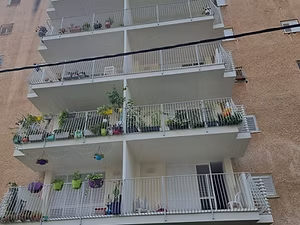
A company of professional and experienced contractors, engineers, architects, and structural engineers whose role is to assess feasibility and present alternatives according to the on-site conditions and the residents’ unique needs.
We will help you choose the balcony type that suits you best.
In 1980, the Israeli Standard for earthquake-resistant construction (IS 413) came into effect—a standard that established engineering guidelines for constructing buildings capable of withstanding earthquakes.
Therefore, buildings constructed in Israel before 1980 were not built according to the strict earthquake-resistance standard and, as a result, these structures are at a higher risk of collapse.
It is estimated that there are also many buildings constructed after 1980 that do not comply with earthquake-resistant building regulations, mostly due to neglect and negligence, but also as a result of normal wear and tear, natural damage, and soil subsidence.
The most decisive action residents can take is to ensure that the building they live in complies with the standard’s requirements, thereby avoiding intervention by local authorities, the issuance of orders and fines, and the designation of the building as a hazardous structure.
There are several warning signs that should raise red flags:
Exposed rebar, flaking or spalling concrete, cracks in the building’s walls, cracks above the connections of beams and columns, rusty rebar, crumbling or loose wall coverings, leaks from the roof, dampness, and mold.
Additionally, pay attention to settlements and tilts in the building, which may result from several causes, such as:
Soil subsidence, bursting of the building’s pipes and water accumulation beneath the foundations, and renovations in neighboring buildings or within the building’s apartments.
Vigilance by the building committee and residents is very important for detecting and locating problem areas.
Therefore, it is recommended that the building committee conduct a dedicated and thorough inspection of the building periodically to identify defects and hazards in the structure.
All parts of the building should be inspected from top to bottom (roof, exterior and interior walls in the building lobby, columns, underground parking, etc.).
If you identify one or more of the above defects, you should contact a professional—either a certified engineer or structural engineer—who will conduct an on-site inspection and review the building’s framework according to the Building Maintenance Standard.
At the end of the process, the engineer or structural engineer will provide their findings along with a detailed plan of the identified defects.
Building reinforcement work begins with an assessment of the structure by a certified engineer, who will conduct a professional engineering inspection of the building’s framework and foundations.
At the end of the inspection, the engineer will submit a report determining whether the building requires reinforcement and will provide an engineering specification detailing all defects, weak points in the building, and the required level of repair and reinforcement.
An experienced and professional contractor will help you choose the optimal solution for each defect, and based on the engineer’s report, will carry out comprehensive architectural planning that includes all work components, the duration of the work, and its cost. The architectural plan is then submitted to the local planning and building committee to obtain a building permit.
The process of obtaining a permit is complex and sometimes lengthy, so it is important that before submitting the plan to the local committee, the residents make joint decisions regarding any additions or modifications that require approvals (such as replacing wall coverings, adding structures like balconies, storage rooms, safe rooms, and more).
Building reinforcement works
Column reinforcement and thickening – the building’s columns bear the entire weight load of the structure.
Reinforcing and thickening the supporting columns increases their load-bearing capacity and makes them more durable, thereby enhancing the building’s resistance to earthquakes.
The process of repairing concrete columns must be carried out according to a detailed engineering plan prepared by an engineer or structural engineer.
The process is carried out in several stages:
Building additions – adding safe rooms (Mamads) is one of the most effective ways to reinforce a structure.
Beyond the obvious security advantages offered by a safe room (Mamad), another benefit is its contribution to the building’s structural reinforcement.
Safe rooms (Mamads) have independent and particularly strong foundations that connect to the existing structure, thereby contributing to its stability. In buildings where safe rooms are stacked on top of each other, the structure can be further reinforced, as the safe rooms create a "spine" for the existing building, providing it with exceptional stability and protection against earthquakes.
By adding a safe room (Mamad), you gain in every aspect: building reinforcement and appearance, personal protection, and an additional room in your home.
Additionally, various building additions, such as expanding apartments, adding an entire wing to the building, or adding concrete balconies, will improve the building’s stability, as these additions expand the existing foundation, help transfer loads to the ground, and enhance the building’s resistance to earthquakes.
Carbon fibers – an innovative method for reinforcing buildings using composite materials that are strong, thin, and extremely lightweight, offering a fast, cost-effective, and flexible solution.
Carbon fiber sheets are made of an elastic, flexible, and exceptionally strong material, with their main advantage being the material’s high tensile strength, which allows a certain degree of flexibility and movement in the structure.
During an earthquake, carbon fibers allow the structure to stretch and the building to move, enabling it to withstand ground movement without the risk of collapse.